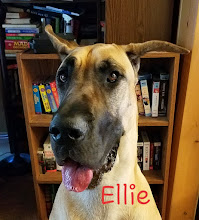
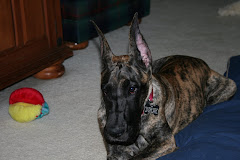
She's still very green here, but so happy and willing to work. I love her attitude.
Showing posts with label training. Show all posts
Showing posts with label training. Show all posts
Tuesday, July 08, 2014
Dakota's first agility run
Dakota's first Agility Q, in Standard! This was taken last spring.
She's still very green here, but so happy and willing to work. I love her attitude.
She's still very green here, but so happy and willing to work. I love her attitude.


Sunday, May 13, 2012
Wednesday, March 03, 2010
What a GOOD boy!!
 Gus's owners sent me this photo of Gus working (quite successfully, I might add) on "Leave It". She said the limiting factor was the drool - they released him to gobble his treats before he soaked everything in sight! Don't be taken in by the sad puppy eyes - Gus has it pretty good!
Gus is one of Kinsey's pups - he is Teddy and Topper's brother.
In case you are new to this blog and wonder why his owners send us photos even though he is almost 5 years old, you should know that reputable breeders always try to stay in touch with their puppy buyers. Not in a controlling way, but to provide support and answer questions and in general to do everything in their power to ensure that both the dog and the family stay happy with each other. And if worse comes to worse and the owners can't keep the dog for some reason - and catastrophic things can happen to the best homes - then the responsible breeder will either take the dog back, or help to find him a new home. We do this because we LOVE every single puppy we ever produce, and we truly care about them and will move Heaven and earth to keep them out of shelters, or out of bad situations.
The promise I make to every newborn puppy is this: "You will be loved for your entire life. You won't always get your way, but you will ALWAYS be loved". And I will do everything in my power to keep that promise.
So if you are in the market for a puppy and encounter a breeder who asks lots of personal questions about your family situation and they also want (or require) you to stay in touch with them after you take the puppy home - that is a great sign that you have found a responsible breeder. And chances are they will be a help to you for the life of that dog.
Sunday, February 08, 2009
Regarding the Dewclaw
I have had many dogs with front dewclaws (the "thumbs") and many who had their dewclaws removed in infancy. I've never really noticed much difference one way or another. During my tenure as a vet tech we'd see dogs with broken or torn dewclaws every now and then although it wasn't a common injury. But they were difficult to treat, mostly because of the difficulty in preventing the dog from licking the area compulsively.
One advantage of having a dog with no dewclaws is that it means two fewer nails to trim - and although my crew is good about that, it still saves a bit of time on each dog.
Kinsey and her sister Aeryn had their dewclaws removed shortly after they were born, so I really wasn't concerned about having the dewclaws removed from Kinsey's pups when they were two days old.
However, since then (that litter turned 3 last summer) I've learned about some of the cons of dewclaw removal in performance dogs. Chris Zink, DVM is a veterinarian and consultant about canine sports medicine and she is a big proponent of leaving front dewclaws where they are.
She says they are important to prevent torque on the foreleg, and to maintain the integrity of the carpal joint. Specifically in her article With a Flick of the Wrist she says: "In the canter, there is a moment during each stride when the dog's accessory carpal pad (on the back of the carpus) of the lead front leg touches the ground and the rear legs and other front leg swing forward to prepare for the next stride. At this point, the dewclaw is in contact with the ground and if the dog turns, the dewclaw can dig in for extra traction to prevent unnecessary torque on the front leg. Without the gripping action of the dog's 'thumbs’ there is more stress on the ligaments of the carpus. This may cause the ligaments to stretch and tear over time, resulting in joint laxity and ultimately, arthritis."
I have actually been a little skeptical about this. Of course, I understand that at speed and/or when turning, a dog's pasterns extend just like a horse's do and will drop low to the ground to absorb shock. But I photograph and film my dogs a lot, and have never seen anything near to the degree of pastern extension she's talking about. The thought of that dewclaw actually touching the ground seems sort of unlikely.
And then I ran across this photo from a bunch I took of Kinsey at an agility trial a few months ago: It's not a great photo and I was about to discard it when I took another look:
 The red circle is about where her dewclaw would be if she had one. And, yes, it does look like it would be contacting the ground if it were there.
I'm still not totally convinced... "touching" the ground isn't the same thing as "digging in" and it doesn't look to me like her pastern is THAT extended.
But it sure gives me something to think about.
One advantage of having a dog with no dewclaws is that it means two fewer nails to trim - and although my crew is good about that, it still saves a bit of time on each dog.
Kinsey and her sister Aeryn had their dewclaws removed shortly after they were born, so I really wasn't concerned about having the dewclaws removed from Kinsey's pups when they were two days old.
However, since then (that litter turned 3 last summer) I've learned about some of the cons of dewclaw removal in performance dogs. Chris Zink, DVM is a veterinarian and consultant about canine sports medicine and she is a big proponent of leaving front dewclaws where they are.
She says they are important to prevent torque on the foreleg, and to maintain the integrity of the carpal joint. Specifically in her article With a Flick of the Wrist she says: "In the canter, there is a moment during each stride when the dog's accessory carpal pad (on the back of the carpus) of the lead front leg touches the ground and the rear legs and other front leg swing forward to prepare for the next stride. At this point, the dewclaw is in contact with the ground and if the dog turns, the dewclaw can dig in for extra traction to prevent unnecessary torque on the front leg. Without the gripping action of the dog's 'thumbs’ there is more stress on the ligaments of the carpus. This may cause the ligaments to stretch and tear over time, resulting in joint laxity and ultimately, arthritis."
I have actually been a little skeptical about this. Of course, I understand that at speed and/or when turning, a dog's pasterns extend just like a horse's do and will drop low to the ground to absorb shock. But I photograph and film my dogs a lot, and have never seen anything near to the degree of pastern extension she's talking about. The thought of that dewclaw actually touching the ground seems sort of unlikely.
And then I ran across this photo from a bunch I took of Kinsey at an agility trial a few months ago:
 It's not a great photo and I was about to discard it when I took another look:
 The red circle is about where her dewclaw would be if she had one. And, yes, it does look like it would be contacting the ground if it were there.
I'm still not totally convinced... "touching" the ground isn't the same thing as "digging in" and it doesn't look to me like her pastern is THAT extended.
But it sure gives me something to think about.
Tuesday, December 16, 2008
Sophie
Over the past 15 years, I've probably fostered 50 or 60 Great Danes in my home. These are/were dogs who were either lost and their owners couldn't be found, or they were surrendered by their owners for various reasons. I worked with established Dane rescue organizations that were responsible for taking in the dogs, finding temporary (foster) housing for them, paying the medical expenses to get them healthy and get them spayed or neutered, and for finding new permanent homes for the dogs.
My responsibility - as the temporary or foster home - was to teach the dog how to live with people as a member of the family (if it didn't know this already and many of them didn't) and to assess the dog in an attempt to decide which sort of family would be the best fit for the dog in the long run. And sometimes I also had to help nurse the dog back to health before they could even be put up for adoption.
Sometimes this was a big job - I got many dogs who had obviously not had ANY training at all, and once they reached adolescence they could be a handful. Think of a hyper, untrained "puppy" who weighs over a hundred pounds and you get the picture. But fortunately Danes are usually pretty quick to figure out what is in their best interest, and once they realized that unacceptable behavior resulted in undesirable consequences then it all became just a matter of teaching the dog what WAS acceptable. I called it "boot camp" but it wasn't really harsh - just a set of simple rules that were enforced with great consistency.
But many times it was actually an easy job. I had lots of foster dogs who were quite mellow and not interested in testing the limits at all, but were just thrilled to get some TLC, and having plenty to eat and a comfortable place to sleep were just icing on the cake.
Most of them were really nice dogs, who were destined to be beloved pets - but while I loved them all I didn't fall in love with them. I didn't think of them as being "my" dogs - which isn't such a good idea anyway if you are fostering, it is hard on the person and can be confusing for the dog - but rather I thought of them as "someone else's dog" that I was just taking care of for awhile. Which was the truth, in a way. So when they got adopted, it really wasn't all that hard to say good-bye to them. I stayed in touch with their new owners, and it was satisfying to see how happy they were. But that was about it.
A few of them weren't so nice - dogs who were so damaged by a disastrous mix of bad genetics and bad upbringing that we soon realized they could be dangerous. Danes are SO big and SO strong that no reputable Dane rescue will try to place such dogs with members of the public. The potential for catastrophic damage is too great. Sometimes an experienced Dane owner comes along who can handle such a dog safely, but most of the time we have to put them down. It's a very difficult decision, and we do our best to make it a peaceful event by feeding the dog treats or letting him have a special toy, sedating him if he doesn't tolerate handling or restraint (so his last moments won't be full of struggle or panic) and generally comforting the dog the best we can. Fortunately this was very rare - in my experience only two dogs I fostered had to be put down.
But there were others - also just a few, but memorable - who really captured my heart. I only succumbed to one and adopted her - that was Patience and it wouldn't have mattered at the time whether or not it was a "good" time to acquire a new dog. Fortunately it was, but I would have kept her regardless because I realized very quickly that she was "my" dog. There is more about her on her memorial page on our web site and also on our info page.
There were 4 or 5 other really, really special ones that I was sorely tempted to keep, but in the end realized that - to be fair to the dog - either I just didn't have the time to do right by them, or for some other reason they would be a better fit for another family. Those were the ones that although it nearly broke my heart to let them go, I later was glad that I had when I saw how happy they were, and how happy their new families were with them. Actually, now that I think about it, it was very good training for being a breeder and being able to let puppies go to their new homes! That is hard to do, too.
Anyway, one of those super special dogs was an adorable puppy bitch named Sophie. She was a fawnaquin, which although it isn't one of the recognized (i.e. showable) colors for Danes is still very pretty and flashy. She was not only friendly and outgoing and confident, but was smart as a whip, and I happened to have her about the time I first learned about clicker training. I experimented shamelessly on her and the results were nothing less than spectacular. I could teach her a new behavior, or a new trick in about 10 minutes, tops - and her retention was perfect.
 Sophie coming home with me - is she adorable or what?
 What a face!!
I had her for only a few weeks, but have a lot of happy memories from that time because I was able to do a lot with her. We went to training classes, we went on walks and outings, and on one memorable occasion we got kicked out of an AKC show.
You usually aren't allowed to bring dogs who aren't entered in a show onto the show grounds, although exceptions are made for various reasons. And it is strictly prohibited to bring in a puppy less than 6 months old - which is the minimum age for showing a dog in AKC conformation classes. Sophie at the time was about 4 months old - she'd had all her vaccinations so it wouldn't hurt her to bring her, but she was obviously too young. I was showing Patience in obedience, but we didn't have any of our dogs entered in conformation that weekend, and after Patience and I were done I wanted to go watch the judging and see some people I knew. It was a local show, so I decided to bring Sophie along. We had a great time, and Sophie did not disappoint. She walked boldly into that huge building, echoing with the (not so) subdued roar of hundreds of people talking and a couple thousand dogs barking. All the sights and smells and sounds can be overwhelming even to worldly-wise adult dogs - never mind a puppy. But her tail was wagging and she was absolutely thrilled by it all. We watched the Dane judging and talked to LOTS of people, and Sophie got petted and fussed over and got her picture taken dozens of times.
 Sophie at the show
 Sophie and Patience doing a Sit - Stay for pictures at the show
Then one of the members of the Kennel Club that was hosting the show walked up to me and asked, "How old is that puppy?" I knew the jig was up but lied anyway, in a most half-assed way: "Six months?" I asked. It was such a bad lie it was kind of funny and he almost smiled, but just said "I don't think so. Please take her out of the building". So I got kicked out of an AKC show for the first and (hopefully) last time. I'm such a troublemaker.
I really, really was tempted to keep her, but I do believe that things often work out the way they are meant to. And when this absolutely fabulous family asked about adopting her, the writing was on the wall. It would be best for all if she became their dog. It damn near killed me to let her go, but I've never regretted it. Her owners stay in touch, and Sophie has developed into the amazing dog we knew she would be. She's had lots of adventures but has remained that happy, sweet smart girl that I knew all those years ago.
Today her owner emailed me to say that they had to say good-bye to Sophie yesterday. She was healthy and happy up until the last few days, when it sounds like a cascade of things started going wrong despite everyone's best efforts. Euthanizing her was obviously the right thing to do, and she was with the people she loved at the end, just as they had been with her for all these years. But I know how hard it was on them, and my prayers and good wishes are with them tonight.
 Sophie in her new home
Farewell, Sophie. You were one of the Special Ones.
My responsibility - as the temporary or foster home - was to teach the dog how to live with people as a member of the family (if it didn't know this already and many of them didn't) and to assess the dog in an attempt to decide which sort of family would be the best fit for the dog in the long run. And sometimes I also had to help nurse the dog back to health before they could even be put up for adoption.
Sometimes this was a big job - I got many dogs who had obviously not had ANY training at all, and once they reached adolescence they could be a handful. Think of a hyper, untrained "puppy" who weighs over a hundred pounds and you get the picture. But fortunately Danes are usually pretty quick to figure out what is in their best interest, and once they realized that unacceptable behavior resulted in undesirable consequences then it all became just a matter of teaching the dog what WAS acceptable. I called it "boot camp" but it wasn't really harsh - just a set of simple rules that were enforced with great consistency.
But many times it was actually an easy job. I had lots of foster dogs who were quite mellow and not interested in testing the limits at all, but were just thrilled to get some TLC, and having plenty to eat and a comfortable place to sleep were just icing on the cake.
Most of them were really nice dogs, who were destined to be beloved pets - but while I loved them all I didn't fall in love with them. I didn't think of them as being "my" dogs - which isn't such a good idea anyway if you are fostering, it is hard on the person and can be confusing for the dog - but rather I thought of them as "someone else's dog" that I was just taking care of for awhile. Which was the truth, in a way. So when they got adopted, it really wasn't all that hard to say good-bye to them. I stayed in touch with their new owners, and it was satisfying to see how happy they were. But that was about it.
A few of them weren't so nice - dogs who were so damaged by a disastrous mix of bad genetics and bad upbringing that we soon realized they could be dangerous. Danes are SO big and SO strong that no reputable Dane rescue will try to place such dogs with members of the public. The potential for catastrophic damage is too great. Sometimes an experienced Dane owner comes along who can handle such a dog safely, but most of the time we have to put them down. It's a very difficult decision, and we do our best to make it a peaceful event by feeding the dog treats or letting him have a special toy, sedating him if he doesn't tolerate handling or restraint (so his last moments won't be full of struggle or panic) and generally comforting the dog the best we can. Fortunately this was very rare - in my experience only two dogs I fostered had to be put down.
But there were others - also just a few, but memorable - who really captured my heart. I only succumbed to one and adopted her - that was Patience and it wouldn't have mattered at the time whether or not it was a "good" time to acquire a new dog. Fortunately it was, but I would have kept her regardless because I realized very quickly that she was "my" dog. There is more about her on her memorial page on our web site and also on our info page.
There were 4 or 5 other really, really special ones that I was sorely tempted to keep, but in the end realized that - to be fair to the dog - either I just didn't have the time to do right by them, or for some other reason they would be a better fit for another family. Those were the ones that although it nearly broke my heart to let them go, I later was glad that I had when I saw how happy they were, and how happy their new families were with them. Actually, now that I think about it, it was very good training for being a breeder and being able to let puppies go to their new homes! That is hard to do, too.
Anyway, one of those super special dogs was an adorable puppy bitch named Sophie. She was a fawnaquin, which although it isn't one of the recognized (i.e. showable) colors for Danes is still very pretty and flashy. She was not only friendly and outgoing and confident, but was smart as a whip, and I happened to have her about the time I first learned about clicker training. I experimented shamelessly on her and the results were nothing less than spectacular. I could teach her a new behavior, or a new trick in about 10 minutes, tops - and her retention was perfect.
 Sophie coming home with me - is she adorable or what?
 What a face!!
I had her for only a few weeks, but have a lot of happy memories from that time because I was able to do a lot with her. We went to training classes, we went on walks and outings, and on one memorable occasion we got kicked out of an AKC show.
You usually aren't allowed to bring dogs who aren't entered in a show onto the show grounds, although exceptions are made for various reasons. And it is strictly prohibited to bring in a puppy less than 6 months old - which is the minimum age for showing a dog in AKC conformation classes. Sophie at the time was about 4 months old - she'd had all her vaccinations so it wouldn't hurt her to bring her, but she was obviously too young. I was showing Patience in obedience, but we didn't have any of our dogs entered in conformation that weekend, and after Patience and I were done I wanted to go watch the judging and see some people I knew. It was a local show, so I decided to bring Sophie along. We had a great time, and Sophie did not disappoint. She walked boldly into that huge building, echoing with the (not so) subdued roar of hundreds of people talking and a couple thousand dogs barking. All the sights and smells and sounds can be overwhelming even to worldly-wise adult dogs - never mind a puppy. But her tail was wagging and she was absolutely thrilled by it all. We watched the Dane judging and talked to LOTS of people, and Sophie got petted and fussed over and got her picture taken dozens of times.
 Sophie at the show
 Sophie and Patience doing a Sit - Stay for pictures at the show
I really, really was tempted to keep her, but I do believe that things often work out the way they are meant to. And when this absolutely fabulous family asked about adopting her, the writing was on the wall. It would be best for all if she became their dog. It damn near killed me to let her go, but I've never regretted it. Her owners stay in touch, and Sophie has developed into the amazing dog we knew she would be. She's had lots of adventures but has remained that happy, sweet smart girl that I knew all those years ago.
Today her owner emailed me to say that they had to say good-bye to Sophie yesterday. She was healthy and happy up until the last few days, when it sounds like a cascade of things started going wrong despite everyone's best efforts. Euthanizing her was obviously the right thing to do, and she was with the people she loved at the end, just as they had been with her for all these years. But I know how hard it was on them, and my prayers and good wishes are with them tonight.
 Sophie in her new home
Farewell, Sophie. You were one of the Special Ones.
Wednesday, November 26, 2008
Notes from Agility class
Tuesday night is Agility class night, at least it has been lately. I love, love, love our agility instructor (Debbie Spence, PAWSative Agility Working School - if you're in the north Texas area near D/FW I can't recommend her highly enough) but it is a bit of a drive to get out there, so lately we've been able to consolidate things and take all 3 dogs to class on the same night.
At PAWS, once you and your dog are through with the carefully structured Beginner class which takes about 12 weeks, you enter classes that are ongoing but organized into five or six different "levels". As the dog and the handler progress in skill and knowledge you get promoted to the next level. At each level the courses and exercises become progressively more difficult - but even at Level 2 (the first one after Beginner) we get instruction and practice on courses that are short, but have elements that are technically difficult. For the handlers, that is.
In the Level 2 class, Ronnie runs Teddy and I run Topper. (She's the brindle girl in my avatar). With Topper, to say I "run" her is an exaggeration. Not only am I not exactly built for speed, but she - as I knew she would - demands a lot of reinforcement for everything. She's not unwilling, or scared (except of the dogwalk, more on that later). She's sweet, and cooperative, and very food motivated... but also must be convinced that anything we expect her to do is in her best interest.
In other words, "What's in it for me?" should be tattooed across her stripey forehead. That would save a lot of time. Either that, or I should let her wear her "I'm a Princess" tiara more often.
So I'm still reinforcing everything - even the easiest and most basic elements like jumping and the start line - stay very heavily. Which tends to slow things down a LOT because I keep stopping to reward her with a treat and lots of ego stroking. But it's working - she's offering more and more things every day. Tonight she actually "sucked" (meaning she chose to enter even though that wasn't part of the plan) to a curved tunnel and then also the chute which - although technically a mistake - is GREAT to see. Let's face it, those obstacles are not easy for a Dane who has to get waaaay down and crawl through them and I'm thrilled that she's deciding that they are fun after all. Her "Go!" (as in "on ahead of me") is improving and I got a couple of nice rear crosses (meaning the handler changes sides for a change of direction behind the dog).
I think she's doing great, and we're having a ton of fun. She is still scared of the dogwalk - she had a pretty bad fall off of it a while ago which was ENTIRELY my fault. But climbing on things is something she's loved to do since she could crawl - she's not called "Topper" for nothing. We are taking the dogwalk slowly - just taking a few steps up the ramp and then letting her hop off - and she's very wiling to keep trying so I'm confident we'll fix that in time.
Teddy is so different. His attitude is "What do you want me to do?" All you have to do is show him what you want and he'll do his best. And he is so FAST. I think he developed the speed as a survival mechanism: his mother and sister chase him all the time and they are merciless! The main challenge Ronnie has with Ted is just planning ahead - so often Teddy lands farther out from a jump than Ronnie anticipated and it's really hard to signal early enough that Teddy has time to respond. But they're getting their act together and really starting to understand each other. Teddy is a lot more advanced in his training than his sister, and is entered in his first agility trial the first weekend of December - I don't think he's quite ready but it won't hurt anything to give it a try. He'll be fun to watch - I'll try to get some video of it.
Their mother Kinsey, who is in a more advanced class later in the evening, is doing great. She and Ronnie are a pretty well-oiled team by now. She loves the running and jumping part, and doesn't mind doing tunnels or the dogwalk or anything else... except the damn Table. That is what has kept her from qualifying in Standard - she still doesn't even have her Open title in Standard - even though in the Jumpers with Weaves class (which has no Table) she is halfway to her Masters title. She'll hop on the table OK, but then at a trial she knows that Ronnie can't touch her, and doesn't have any food on him so she seems to make a game of seeing how high she can push his blood pressure. Her expression ranges from "What is this 'Down' you speak of??? I've never heard that command before!" (picture a charmingly cocked head) to a very simple "I don't wanna, and you can't make me!" A few weekends ago she had a near perfect run in Open Standard, except it took Ronnie about 30 seconds to get her to lie down on the Table. Which of course ran them over time and they didn't qualify.
Again.
At PAWS, once you and your dog are through with the carefully structured Beginner class which takes about 12 weeks, you enter classes that are ongoing but organized into five or six different "levels". As the dog and the handler progress in skill and knowledge you get promoted to the next level. At each level the courses and exercises become progressively more difficult - but even at Level 2 (the first one after Beginner) we get instruction and practice on courses that are short, but have elements that are technically difficult. For the handlers, that is.
In the Level 2 class, Ronnie runs Teddy and I run Topper. (She's the brindle girl in my avatar). With Topper, to say I "run" her is an exaggeration. Not only am I not exactly built for speed, but she - as I knew she would - demands a lot of reinforcement for everything. She's not unwilling, or scared (except of the dogwalk, more on that later). She's sweet, and cooperative, and very food motivated... but also must be convinced that anything we expect her to do is in her best interest.
In other words, "What's in it for me?" should be tattooed across her stripey forehead. That would save a lot of time. Either that, or I should let her wear her "I'm a Princess" tiara more often.
So I'm still reinforcing everything - even the easiest and most basic elements like jumping and the start line - stay very heavily. Which tends to slow things down a LOT because I keep stopping to reward her with a treat and lots of ego stroking. But it's working - she's offering more and more things every day. Tonight she actually "sucked" (meaning she chose to enter even though that wasn't part of the plan) to a curved tunnel and then also the chute which - although technically a mistake - is GREAT to see. Let's face it, those obstacles are not easy for a Dane who has to get waaaay down and crawl through them and I'm thrilled that she's deciding that they are fun after all. Her "Go!" (as in "on ahead of me") is improving and I got a couple of nice rear crosses (meaning the handler changes sides for a change of direction behind the dog).
I think she's doing great, and we're having a ton of fun. She is still scared of the dogwalk - she had a pretty bad fall off of it a while ago which was ENTIRELY my fault. But climbing on things is something she's loved to do since she could crawl - she's not called "Topper" for nothing. We are taking the dogwalk slowly - just taking a few steps up the ramp and then letting her hop off - and she's very wiling to keep trying so I'm confident we'll fix that in time.
Teddy is so different. His attitude is "What do you want me to do?" All you have to do is show him what you want and he'll do his best. And he is so FAST. I think he developed the speed as a survival mechanism: his mother and sister chase him all the time and they are merciless! The main challenge Ronnie has with Ted is just planning ahead - so often Teddy lands farther out from a jump than Ronnie anticipated and it's really hard to signal early enough that Teddy has time to respond. But they're getting their act together and really starting to understand each other. Teddy is a lot more advanced in his training than his sister, and is entered in his first agility trial the first weekend of December - I don't think he's quite ready but it won't hurt anything to give it a try. He'll be fun to watch - I'll try to get some video of it.
Their mother Kinsey, who is in a more advanced class later in the evening, is doing great. She and Ronnie are a pretty well-oiled team by now. She loves the running and jumping part, and doesn't mind doing tunnels or the dogwalk or anything else... except the damn Table. That is what has kept her from qualifying in Standard - she still doesn't even have her Open title in Standard - even though in the Jumpers with Weaves class (which has no Table) she is halfway to her Masters title. She'll hop on the table OK, but then at a trial she knows that Ronnie can't touch her, and doesn't have any food on him so she seems to make a game of seeing how high she can push his blood pressure. Her expression ranges from "What is this 'Down' you speak of??? I've never heard that command before!" (picture a charmingly cocked head) to a very simple "I don't wanna, and you can't make me!" A few weekends ago she had a near perfect run in Open Standard, except it took Ronnie about 30 seconds to get her to lie down on the Table. Which of course ran them over time and they didn't qualify.
Again.
Sunday, October 21, 2007
Speaking of Rally...
...Teddy finished his Rally Novice title today!! He was so good! Admittedly, the Novice level in Rally is not terribly difficult... but it does require teamwork between dog and handler, and the ability to perform various basic Obedience exercises and parts of more advanced exercises.
Teddy has the potential to do very well in Obedience and Agility, if his owner (moi) can get busy and work with him more regularly. His attitude is "What do you want me to do?"* - which you have to admit is a great one for a dog to have!
*Unlike his sister Topper, whose attitude is more along the lines of "What have you done for me, lately?"
Teddy says: "Now give me a cookie!"
To give you an idea of what a Rally course is like, here is the map of the course we had today in the Novice class: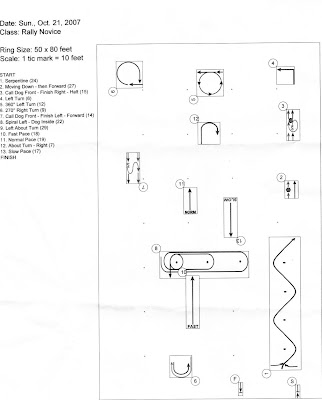
The first exercise consisted of the dog & handler weaving in & out of 4 cones. The second exercise requires the dog to drop into a Down next to the handler - the handler gives this command while the team is still moving forward. Next, the handler calls the dog to sit in Front. Then the dog moves around behind the handler and sits in Heel position at the handler's left side.
The 4th sign is for a Left turn. The exercise after that requires the team to make a small circle to their Left. Exercise #6 is a 270 degree turn - it's called a "270 Right Turn" because the team turns to their Right as they make this turn... but it's actually a Left turn.
Exercise #7 requires the handler to call the dog to sit in Front, then move to the handler's Left side to get back into Heel position. But this time, the handler begins moving forward before the dog sits. Exercise #8 is a Spiral Left - meaning the team turns toward their Left, into the dog. Spirals in Rally are a series of concentric ovals - you do the largest one first. Exercise #9 is the Left About Turn - the handler makes a quick Left turn toward the dog, and the dog meanwhile circles behind the handler and winds up back on the Left side. I really enjoy this particular turn, but it can be confusing for some people to learn. It reminds me of a square dancing move! (I'm probably sounding really old here - do they still teach square dancing in elementary schools?? Somehow I think not! But they did when I was there.)
The next exercise calls for a Fast pace - the handler should break into a trot, and the dog should keep up. At the "Normal Pace" sign, the team slows to their normal (should be brisk) walking pace. Exercise #12 is a Right About Turn - the team makes a tight 180 degree turn to the right. The last exercise sign calls for a Slow pace - the handler should noticeably slow down and again, the dog should adjust to stay in position. I tell my students that the Fast should be the sort of quick trot you'd do to catch an elevator. The Slow should be a window-shopping stroll, and the "Normal" pace should be a brisk but comfortable walk. As the team passes the Finish sign, they're done!
Through all the exercises on a Novice course like this, the handler is free to talk to the dog, give multiple commands and/or hand signals, even pat his/her leg or clap hands. The dog is on lead throughout. It's a lot of fun, and like I said above, not too difficult. Hopefully as you are reading this you are thinking that maybe this is something you could do with YOUR dog!!
Tuesday, October 16, 2007
More Rally

As I mentioned in my previous post, Rally Obedience can be a great option for a veteran dog who just can't compete in regular Agility or Obedience any more, but who is still healthy and active and hates to be left at home.
Patience was a perfect example of that. We had competed in regular obedience when she was younger and she finished her UD (Utility Dog title). We also dabbled in Agility but didn't ever compete in that. In 2005 when the AKC made Rally a titling event, Patience was 10 years old - she certainly qualified as a Veteran dog! But she was still very healthy and active and loved to go to shows. In the fall of 2004 she had won the Veteran's Obedience class at the Great Dane National, and did so in fabulous style. So I figured she would probably like Rally.
Boy did she! Starting the first weekend in January, we went to every Rally trial we could find within a reasonable driving distance. It takes 3 qualifying scores to get a Rally Novice title; 3 to get a Rally Advanced title; 3 to get a Rally Excellent title (Novice, Advanced and Excellent are three tiers of competition, with each a little more difficult than the last) and to get a Rally Advanced Excellent title you have to qualify in both the Excellent class and the Advanced class at the same trial for one leg... and it takes 10 of those legs to finish the RAE title! That is a minimum of 29 qualifying scores.
Patience dove right in, and got those 29 qualifying scores in a row - not only never had a non-qualifying score but she had several perfect scores and lots of class placements. She finished the RAE title just 6 months after starting in Rally Novice, and was the first Great Dane in the US to finish the RAE title. In fact, she was the 8th dog of any breed in the whole country to finish it, and the first dog of any breed in Texas.
All for a Dane nearly 11 years old (her birthday was in July). I believe that keeping older dogs active -within reason - helps them live longer and healthier. I do think this return to the show ring really revived Patience. She lived to be nearly 12, and I miss her every day.
Rally On!
First, let me just say... I love Rally Obedience! Love, love, Love It!
What is Rally, you may ask? (and you may!)
It's an event that has been described as a cross between Agility and regular Obedience. The handler and dog navigate a course (like Agility) but instead of tunnels and weave poles and such, the "obstacles" on the course consist of Obedience exercises. Signs on the course tell the handler what exercise is required. The signs are numbered in the order the handler and dog are to perform them, and (as in Agility) the handler has the opportunity to walk the course before the class starts without the dog, in order to become familiar with the course.

For example, this sign directs the handler to come to a halt with the dog sitting in Heel position. Then the handler directs the dog to lay Down (still in Heel position). The handler tells the dog to Stay, and walks completely around the dog and back to Heel position. Once back in Heel position, the handler pauses to release the dog from the Stay and they proceed to the next exercise.
Also like Agility, throughout the course the handler is permitted to talk to the dog, give hand signals, use body language etc. in order to communicate what the handler wants the dog to do. This is one of the reasons Rally has become so popular, because in regular Obedience the handler is strictly limited in what you can say to the dog during the exercises, or what hand signals you can use.
The ability to talk freely to your dog during a Rally course makes it easier to keep the dog "up" and also is more relaxing for the handler!
I've been teaching Rally classes since the summer of 2004, and in 2005 Rally became an AKC titling event. I love how Rally is at once a great option for novice dogs and handlers just coming out of a basic Beginner obedience class; and at the same time is a fun option and stress reliever for advanced dogs and handlers. Since it is easier than regular obedience - and although some jumping is required at the Advanced and Excellent level, it is minimal - Rally is also a terrific option for a veteran dog who can't compete any longer in regular Obedience or Agility but who is too healthy to be happy just sitting at home.
For more information, go to RallyObedience.com or to the AKC Rally Regulations
Saturday, October 06, 2007
Agility!
Yes, in case you were wondering, Great Danes CAN do Agility. That is the dog event based on equine jumper courses where the dogs run and jump, crawl through tunnels, and climb over various obstacles.
The obstacles are really sized for medium to large dogs, but the Giant sized dogs seem to enjoy it too. You do have to be careful when training Giant breed puppies to do agility. Since they grow so fast and so much, it is possible to injure them.
Some basic rules are:


The obstacles are really sized for medium to large dogs, but the Giant sized dogs seem to enjoy it too. You do have to be careful when training Giant breed puppies to do agility. Since they grow so fast and so much, it is possible to injure them.
Some basic rules are:
- Keep jump heights low with a young dog. My rule of thumb is ankle height until 6 months of age, then elbow height until at least 18 months old.
- Introduce tunnels while the puppy is still short enough to run through the tunnel without crouching, if possible. Once he gets taller than the tunnel, practice having him go through a tunnel only once a month or so until he's mostly grown. Don't overdo the tunnels even with a mature dog - it can be really tiring.
- Be careful teaching weave poles. The back & forth movement can put a strain on the dog's shoulders. You can practice these with young Giant breed dogs, but not to excess. 5 or 10 minutes a week is plenty.
There are lots of other great ideas on the ChromaDane web site.
Here are some pictures (courtesy 2MC Designs) of Kinsey from a recent agility trial - there are more on our web site. I finally updated it!

Wednesday, September 12, 2007
Mmmmmmmm baby poop
One thing I did do for the pups' second birthday was make treats for them all. This is a wonderful and VERY easy treat recipe that dogs love.
Although, as one friend observed, they do look a bit like baby poop!
BABY FOOD TREATS
Ingredients:
- 4 small jars baby food (any pureed meat type)
- 1/3 cup Cream of Wheat (you can substitute any kind of flour, but the texture won't be quite so fine)
- 1 beaten egg
Optional: flavorings like garlic powder, grated cheese etc.
For example, I made two flavors in this last batch:
1. Ham & Turkey with grated cheese, and
2. Veal & Lamb with garlic.
Mix all ingredients. If the batter is too runny, add some more Cream of Wheat or flour but it doesn't have to be really thick - just thick enough that when you drop a little spoonful onto the baking sheet it won't completely flatten out.
I usually cook these in the microwave - drop by small spoonfuls onto waxed paper or parchment paper, or a greased microwave safe plate.
For chewy treats, cook on High for 2- 3 minutes, until set.
If you want crunchy treats, cook them longer.
If you want to bake them in the oven, drop by spoonfuls onto a greased cookie sheet and bake at 350 for about 8 minutes for chewy treats, longer for crunchy treats.
Cool and store covered in the fridge for up to one week, or freeze for longer storage.
Why bother, you may ask? Aside from any warm fuzzy feelings arising from making something for a pet you love, your choice of treats to use when training your dog can make or break a training session.
Remember that some treats have more value to the dog than others. Think of it as pay for your dog - and just as we don't demand high pay for a job that is easy and/or enjoyable, your dog will be perfectly satisfied with "low value" treats like his regular dog biscuits, Cheerios, even pieces of his regular food when you are practicing in a low-distraction environment (like at home) or practicing exercises he already knows and enjoys. But move him to a high-distraction environment like a training class, or try teaching him something difficult and if you want his undivided attention he's going to want higher pay for that.
You may have to experiment to find treats that really drive your dog crazy. Some favorites are:
cheese
hot dogs
boiled chicken, liver, etc - especially with a sprinkle of garlic powder
But a variety of treats for training is important, and that's where homemade treats come in handy. And of course, they're lovely as occasional special treats just to do something nice for your dog.
Bake up a batch of these and freeze for future use - your dog will thank you! I'll post other treat recipes here from time to time.
Although, as one friend observed, they do look a bit like baby poop!
BABY FOOD TREATS
Ingredients:
- 4 small jars baby food (any pureed meat type)
- 1/3 cup Cream of Wheat (you can substitute any kind of flour, but the texture won't be quite so fine)
- 1 beaten egg
Optional: flavorings like garlic powder, grated cheese etc.
For example, I made two flavors in this last batch:
1. Ham & Turkey with grated cheese, and
2. Veal & Lamb with garlic.
Mix all ingredients. If the batter is too runny, add some more Cream of Wheat or flour but it doesn't have to be really thick - just thick enough that when you drop a little spoonful onto the baking sheet it won't completely flatten out.
I usually cook these in the microwave - drop by small spoonfuls onto waxed paper or parchment paper, or a greased microwave safe plate.
For chewy treats, cook on High for 2- 3 minutes, until set.
If you want crunchy treats, cook them longer.
If you want to bake them in the oven, drop by spoonfuls onto a greased cookie sheet and bake at 350 for about 8 minutes for chewy treats, longer for crunchy treats.
Cool and store covered in the fridge for up to one week, or freeze for longer storage.
Why bother, you may ask? Aside from any warm fuzzy feelings arising from making something for a pet you love, your choice of treats to use when training your dog can make or break a training session.
Remember that some treats have more value to the dog than others. Think of it as pay for your dog - and just as we don't demand high pay for a job that is easy and/or enjoyable, your dog will be perfectly satisfied with "low value" treats like his regular dog biscuits, Cheerios, even pieces of his regular food when you are practicing in a low-distraction environment (like at home) or practicing exercises he already knows and enjoys. But move him to a high-distraction environment like a training class, or try teaching him something difficult and if you want his undivided attention he's going to want higher pay for that.
You may have to experiment to find treats that really drive your dog crazy. Some favorites are:
cheese
hot dogs
boiled chicken, liver, etc - especially with a sprinkle of garlic powder
But a variety of treats for training is important, and that's where homemade treats come in handy. And of course, they're lovely as occasional special treats just to do something nice for your dog.
Bake up a batch of these and freeze for future use - your dog will thank you! I'll post other treat recipes here from time to time.
Subscribe to:
Posts (Atom)